Monday, February 18, 2013

SoundBytes February 15, 2013

Hard to believe we are already halfway through February and we have lots to talk about this post. Here at SoundTraxx we have a much-anticipated announcement for a new sound file and we have been working on a few new install documents for the decoder selector. Last for our Tech Tip, we’ll discuss the different modes of programming, starting with Service Mode or programming on the programming track.

New Decoder Announcement: TSU-AT1000 for NRE GenSet Locomotives

There have been many requests for a proper sound decoder for the NRE GenSet 3GS21-B Switchers, recently released by Atlas Models. We are pleased to say that we have been working hard on this project to faithfully mimic the operation of the prototype GenSet Switchers. This new decoder will be available in the TSU-AT1000 format, perfect as a drop-in decoder for the Atlas model. The Atlas model comes with prototypical front and rear non-flashing ditch lights that will easily utilize the decoder’s four lighting functions.
Each GenSet prime mover will have its own sound channel that will startup at the proper throttle notch, completely independently of the others, and will rev up and down based on the throttle use and remain on as the loco is used. After use at idle, a timer starts to count and shuts down the second and third GenSet engines as they “cool down.” This independent control of each GenSet engine is what makes this loco unique. You can pre-order yours from your favorite hobby shop now.
The sound sample can be found here: http://www.soundtraxx.com/dsd/tsunami/1000at.php#bot

Application Notes for Athearn Models
We have been working hard to get more installation documents up and listed on our website. These can be found in the Decoder Selector section. This month, we have posted the Athearn Genesis HO SD70MAC. This model uses the TSU-GN1000 for EMD 710 (P.N. 828052) and our small oval (16mm x 35mm) speaker (P.N. 810113).
Athearn Genesis HO SD70MAC Application Note: http://www.soundtraxx.com/documents/appnotes/athearn_sd70mac.pdf

Also, we have added one for the Athearn Ready-To-Roll HO GP35. This model uses the TSU-AT1000 for EMD 567D Turbo (P.N. 828039) and our small oval (16mm x 35mm) speaker (P.N. 810113).
Athearn Ready-To-Roll HO GP35 Application Note: http://www.soundtraxx.com/documents/appnotes/athearn_gp35.pdf

Last, we added the Athearn Ready-To-Roll HO CF-7. This model uses the TSU-AT1000 for EMD 567 (P.N. 828040) and our small oval (16mm x 35mm) speaker (P.N. 810113).
Athearn Ready-To-Roll HO CF-7 Application Note: http://www.soundtraxx.com/documents/appnotes/athearn_cf7.pdf
All of these decoders and speakers are available to ship now.

Tech Tip: Service Mode Programming
With all the discussion on programming tutorials, it seems that the methods can sometimes be overlooked in the process. In the next couple of posts, we’ll share a bit about service mode programming and operations mode programming to set the CVs and the advantages of each method. Starting this time, we’ll look closely at service mode programming using the programming track.
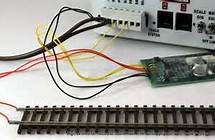
The programming track is an isolated section of track that is designed to communicate programming commands to a decoder. Any loco/decoder on this section of track will accept any programming changes sent from the DCC system. The command station (CS) sends a programming command and the decoder listens and makes the CV changes accordingly. When the decoder acknowledges that is has accepted the change, it then sends a pulse of power to the motor. The CS then detects this small surge of current on the track and relays that it has been programmed okay. If there is not a motor hooked up to the decoder, the command is still obeyed, but the CS will not get the acknowledgement pulse due to the open circuit. This is why many modelers will opt to use a small resistor across the motor leads to simulate the motor load, and consequently the decoder’s acknowledgement pulse.
Programming on the programming track is helpful because you do not need to know the decoder’s address, you can easily make changes, or you can easily regain control of a decoder whose address is not known.
The programming track also allows you to read a CV value, but this is not accomplished as one would expect. To read a CV value, the CS and the decoder play a game of “256 Questions.” The game goes like this: “Is the value of CV# 0?… Is the value of CV# 255?… Is the value of CV# 1?…2?….3?….…254? When the decoder wants to answer “Yes,” the decoder then sends a pulse of power to the motor circuit for the CS to detect a small surge in current. The surge of current is read as a positive answer to the value in question, and the answer is displayed in the CS screen. If there is no motor, or load across the motor leads, the decoder can never be read.
Service mode programming also was designed to be used as a test-bed for decoder installations before going to the mainline. The power on the programming track was set to about ½ power to help protect any faulty wiring from causing permanent damage to the decoder. At the time, non-sound mobile decoders were all that was available, so this worked well. Simply send a programming command and if the decoder accepted the programming, it was ready for the mainline! Now with sound--using the SoundTraxx Tsunami--becoming more dominant in the industry, the lower power available on the programming track is not quite sufficient to “wake up” the higher-powered processors on the sound decoder for programming. This warrants the need of a PTB-100 or Programming Track Booster. Our PTB-100 will amplify the signal on the programming track to allow sound decoders to now reliably read and write CVs on the programming track. It also offers short-circuit protection against faulty wiring to protect the delicate electronics involved, so it does not need to be removed when programming non-sound decoders.
 The PTB-100 also will indicate the stages of the programming process, so you can easily see that the decoder is acknowledging the programming and reading commands. It easily hooks up between the CS and the programming track, so you can set it up once and be done. More information on the PTB-100 can be found here: http://www.soundtraxx.com/access/ptb100.php   
Next time, we’ll look at programming on the mainline, also known as operation mode, and its advantages.

Friday, January 18, 2013

SoundBytes, January 17, 2013

Happy 2013!
It’s hard to believe it’s 2013 already! With the New Year, we’d like to thank each of you for helping make 2012 another successful year! We are looking to the future, so help us make 2013 our best ever! We have our new state-of-the-art manufacturing equipment in place and operational. With this in place, we can shift our sights to the future.
Its NFL Playoffs again, and this year, the New England Patriots and again hosting the Baltimore Ravens.  This year, in anticipation of the event, we had some fun at the office ganging up on Allison and her lone 'paid' Ravens supporter! 
In this post, we’ll say goodbye to a member of the SoundTraxx family, finish our Tech Tip discussion on consist lighting and we’ll visit Yankee Dabbler’s new store in New Jersey.

Farewell and Good Luck!
One of our employees, Rebecca Balboni, decided to leave the fold here at SoundTraxx and pursue a pro cycling career. She has competed across the states and has had great finishes. As she leaves to train, we are hoping to see her at the Olympics in Rio in 2016. If you are interested, you can follow her progress from her blog at http://www.rebeccabalboni.com/  

Customer Newsletter
Starting this month, we will be sending out an official customer newsletter. This will be similar to the blog, but more specifically SoundTraxx and Blackstone Models news only. You can sign up by sending an email to customernews@soundtraxx.com.

Upcoming Show: Amherst Railway Society Railroad Hobby Show, Jan. 26 & 27, Eastern States Expo FairgroundsWest Springfield, MA
We’re excited to head east for the Railroad Hobby Show! Find us in the Better Living Center, Sec. 27, Tables D, E and F. Just look for the big helium balloon! At the show, we’ll have rebate cards available for customers who purchase select SoundTraxx and Blackstone Models products that weekend.

Dealer Spotlight: Yankee Dabbler
Yankee Dabbler has been a strong dealer for SoundTraxx products since April 2009. As a full-line hobby supplier, they have been appearing at shows and selling on the Internet for many years. Now, Bob and his son Mike have opened a new retail store in Bellmawr, NJ.
Catering to the seasoned modeler, this full-line hobby shop is filled with your critical model railroad needs, including SoundTraxx, and soon Blackstone Models! They are located at 101 West Kings Highway in Bellmawr and are open Tuesday through Friday from 11 a.m. to 7:30 p.m., and Saturday from 10 a.m. to 6 p.m. Contact them at (856) 312-8084 and they are always open on the web at www.yankeedabbler.com.

Tech Tip: Lighting for a Consist, Part Deux
Last post, we took a moment to understand how consists are set up using CV 19, 21 and 22. This time, we will look at the lighting specifically and see how this method can be used to better enhance the lighting.

First, let’s look at what lights could be on display of any loco. For all locos, there is the headlight and reverse light. Also in the diesel era, there are auxiliary warning lights, such as Mars light, rotary beacon and ditch lights. As the Tsunami can do all of these and more, the key is to determine which function (F0f, FX5, etc) does what and how these lights are displayed on the loco, or group of locos. For an example for this exercise, we’ll use two locos: a lead loco with ditch lights, and a trailing loco with a rotary beacon.

Lead loco needs to be set up for the lights to operate consistently. For alternating ditch lights, it is common to assign them to a single function button so that they both turn on and off together. In this example we’ll select F5. To do this, a few CVs need to be set, CVs 39, 40, 51, 52. CV39 controls what happens when F5 is active. Since we want both ditch lights on F5, set CV39 to 6 (2 + 4). Since CV40 governs F6, we’ll set that to 0. After this, F5 will illuminate both ditch lights, while pressing F6 will do nothing. To set up the alternating ditch lights, set CV51 to 41 and CV52 to 57 (See User’s Guide for details).


On the trailing loco, the rotary beacon will be set to F6. Typically, it would be wired up to the green wire, but if not, it can be reassigned by changing CVs using a similar method as outlined for the lead loco. Because we’ll assume it is wired to the green wire, the only CV programming for the lighting effects necessary on the trailing unit is to set up the rotary beacon. To accomplish this, set CV52 to 7.
CV49-52
To set up our consist, for this exercise, we’ll look at the lights only. Referring to Section 5.9.1 of the General Code of Railroad (GCOR) rulebook (also known as Rule 17), the lead loco should display the headlights on and dimmable, as well as the ditch lights on. The reverse light would not illuminate because it is facing into the rear unit. The trailing unit would display the reverse light, and optionally the rotary beacon (there is not a universal rule for warning devices, such as our rotary beacon on trailing units, so in this exercise, we will illuminate it because it looks cool. Refer to your prototype railroad’s rulebook for detailed information). Using the method described in our last post, we will set the CVs. First, select a consist address and assign CV19 accordingly. For the lead loco, set CV 21 to 86 (2 + 4 + 16 + 64) and set CV22 to 1. Now set up the trailing loco by setting CV21 to 96 (32 + 64) and CV 22 to 2.
CV21
CV22
Now activate F0, F5 and F6. Your headlight should be on when moving the consist forward, the ditch lights will be illuminated and the trailing loco’s beacon will be on. Pressing F7 will dim the headlight. Press the horn (F2) to initiate the alternating flashing ditch lights. Reverse direction and the headlight on the front unit will go out while the rearward facing light on the trailing unit will come on.


Thursday, December 13, 2012

SoundBytes 12-13-12

The Holidays are upon us and it’s time for gifts! While our fellow modelers are collecting Tsunami sound decoders for that new loco they are getting, we have been getting gifts here too -- new SMT equipment to keep our assembly technology state-of-the-art! We’ll share some photos of us opening our early Christmas presents with you. Since we are focusing on our production floor, we’ll also introduce you to our Production Manager, Brad.

Holiday Hours
We will be closed the week of Christmas from Dec. 24 -28 and on New Year’s Day. We wish a safe and Merry Christmas and Happy New Year to all of our friends!

Brad Schulz: Production Manager
We are happy to introduce you to our Production Manager, Brad Schulz. Brad came to SoundTraxx from South Dakota where he worked in industrial electronics manufacturing making many of the big video screens at sports stadiums around the country.
Brad grew up in Montana with a love for the outdoors. He played football at Chadron State College in Nebraska and also earned a master’s degree in industrial management while working in South Dakota.
During his college football days, Brad played against Fort Lewis College, located here in Durango, and fell in love with the area. When we posted the job opening for a production manager, he jumped at the opportunity to live here full time!
Brad has been at SoundTraxx for 3 years. Since he has come on board, he has helped maintain steady stock levels to minimize backorders, and has lead the expansion of our production team from 5 to 12 people.

New Equipment! It’s Christmas in December!.. Oh… Wait…
Last week, we received a few new machines to improve our production process with the latest and greatest technologies.
For starters, we have a new oven. After the pick-and-place machines locate the components on the raw circuit boards, the panel (consisting of 12-20 decoders) then travels through the oven. This heats up the entire panel to melt the solder paste and permanently attach the components down to the board. The new oven is much bigger to allow better flow of the solder on the board to the components. This has the newest technologies to insure even and consistent soldering while being large enough to expand our production capacities.
Next is our new selective soldering machine. This machine is designed to solder larger solid components to the circuit board using through holes, so this no longer has to be performed by hand soldering. An example of this would be the large super-capacitor mounted on the lighting decoders for the Blackstone Models coaches and cabooses. This has a robotic arm that does the work for more predictable and consistent results.
Also, within a week, we will be receiving a flying probe tester. This machine will go around the circuit boards and electronically test each component to insure that it is the correct part, it is functioning, and that it performs properly in the circuit. This will not replace the functional test we perform on each decoder that allows us to know the decoder is operating as it should.

With the addition of these machines, we are proud to say that our automated decoder manufacturing process has now become lead-free. We are looking forward to the more streamlined manufacturing process and possible expansion capabilities these new machines will bring. By adding in the newest technologies to our process, you can be sure you are getting a quality-manufactured product from the United States!

Tech Tip: Lighting for a Consist, Part 1

This tech tip was requested at Trainfest in Milwaukee by a show attendee. To fully explain this feature, first we must understand how to set up advanced consists. Many command stations offer consist setup, but this is usually stored in the command station, and the function commands are sent to only the lead unit. Therefore, to have the consist of locos perform properly, as if a single loco, they need to be set up using an advanced consist.

First, look at the consist address, which is stored in CV19. This is a two-digit alias that the consist responds to. This is a number between 1 and 127. This address could be the last two digits of the lead loco, a train number on a timetable, a club member ID number, etc. This number is programmed into CV19. When the loco is facing backwards, add 128 to the address. (Ex. Consist 20 for a forward-facing loco would have 20 programmed into CV19, and a rear-facing loco would get 148 programmed in CV19. To control the locos, select loco 20 with the cab and run them together, even though they are facing opposite directions.)

Next, determine which locos are to do what functions based on their location in the consist. These are set using CVs 21 and 22. CV 21 activates F1 through F8,
while CV 22 activates F0f, F0r, and F9 through F12.
The location of the loco determines what functions are active. For an example of two locos consisted, the lead loco will have the headlight (F0f), bell (F1), horn and short horn (F2&3), dynamic brakes (F4), dim (F7) and mute (F8), and brakes (F11). For this example, we will not be using FX5 or 6, or manual notching. The trailing loco will have dynamic brakes (F4), mute (F8), brakes (F11) and the coupler (F12). Now determine the CV values. Following the chart for the lead loco, CV21 = 1 + 2 + 4 + 8 + 64 + 128, so enter a value of 207. CV22 = 1+16, so enter a value of 17. For the trailing loco, CV21 = 8+128, so enter a value of 136. CV22 = 16 + 32, so enter a value of 48. If you had a third loco in the middle, just leave out the coupler clank. This becomes fun, especially when all locos in the consist behave as if they are all one long loco!

Next post, we’ll look in depth at the lights for each loco in the consist.

Monday, November 19, 2012

SoundBytes 11-19-12


First, we want to wish a safe and happy Thanksgiving to all of our fans, customers, fellow modelers and hobby shop dealers. SoundTraxx will be closed on Thursday and Friday, Nov. 22 and 23, so we can feast with our families and friends.
Trade show season is in full swing now. As the weather turns colder, trains are now taking center stage for hobbyists. We have our last show of 2012 coming up in the next month. Also, we’ve been out visiting stores and giving clinics.

Upcoming Show: Oklahoma City Train Show, Dec. 1-2, Oklahoma State Fairgrounds, Oklahoma City
www.okctrainshow.com
We hope to see you at the Oklahoma City Train Show, which has been named one of the Best Train Shows by “Cowcatcher Magazine.”

Show Recap: Trainfest, Nov. 9-11, Wisconsin Exposition Center, Milwaukee
www.trainfest.com
If you were able to attend, you could easily tell this was a great weekend up in Milwaukee. The weather was great and there was a record-setting 25,500+ in attendance.
We were busy greeting our fellow modelers and sharing the great features of the Tsunami decoders. Thanks to all who came and saw us. We always enjoy these shows!

Dealer Spotlight: Traintek, Waltham, Massachusetts
SoundTraxx Vice President Nancy Workman recently visited Traintek in Waltham, Massachusetts.
Nancy met with the owner, Gary Paulino, who graciously showed her his operation.
As you would expect, Gary stocks a lot of product, geared primarily for DCC users. She was happy to see their installation department busily working on installing a Tsunami Digital Sound Decoder during her visit.
If you live in the Boston area, please visit Traintek! They are located at 39 Emerson Road, Suite 203 in Waltham. Their phone number is 888.339.8724. They have an efficient business geared toward customer service, installation, and product availability and would be happy to see you. You also can visit them each year in January at the Big Railroad Show in West Springfield, Massachusetts (at the Big E). Please visit their website at www.traintekllc.com. 

Fan Photo Submission
We are always happy to see what the modelers have been doing with our Blackstone Models products. This submission was from one of our dealers in Luxembourg, KSPS Commerce SARL.
Good to see the flavor of the narrow gauge has infected the European modelers! You can visit their website at http://www.modellbau.lux-cnc.net/  

Clinic Recap
George gave a clinic at the Greeley Freight Station Museum for the Northern Colorado Model Railroad club on Oct. 25.

They filled the house for their business meeting and the clinic.
Another clinic was given at Caboose Hobbies in Denver on Oct. 27. A good crowd was in attendance, as well as some of their employees. A special “Thank You” for the hospitality and interest by both the Northern Colorado Model Railroad Club and Caboose Hobbies for having us up there for these clinics. You can find out more information about the Greeley Freight Station Museum at www.gfsm.org and about the Northern Colorado Model Railroad Club at www.ncmrc.org/index.php.  You can also visit Caboose Hobbies at www.caboosehobbies.com. 

George also taught a clinic at Enginehouse Services in Green Bay, Wisconsin, just before Trainfest on Nov. 6. The clinic was held in a nearby vacant office space to accommodate all who attended.

As always, we want to thank Enginehouse Services for their hospitality and to their patrons for coming out to see what we had to share! You can visit Enginehouse Services at www.enginehouseservices.com. 
SoundTraxx in the News
SoundTraxx was mentioned in the latest La Plata County Economic Development Alliance newsletter. You can see the information here: http://www.investors.yeslpc.com/267/economic-development-alliance-investor-updates/investor-update-october-30-2012. 

Thank you to all of our loyal customers who have helped us become what we are today!

Monday, October 22, 2012

SoundBytes 10-22-12

It has been a busy month so far of “Train Season.” We got started off right at the iHobby Expo in Cleveland, Ohio, and we’ll be traveling to a few shows this winter. In this post, we’ll also cover SoundTraxx and Blackstone Models announcements, as well as a clinic in the Denver and Front Range area.  We'll also introduce you to Vinson's Custom Electronics in our Dealer Spotlight.

Tweeting…
SoundTraxx and Blackstone Models are now on Twitter! Look us up for announcements, news items and general hobby related items.
You can find us at @SoundTraxxCO and @BlackstoneCO. As always, you can find information on our website and Facebook.

Upcoming Shows:
We just finished up with the iHobby Expo in Cleveland. We had a great time catching up with many of our dealers and meeting up with a few new dealers. Over the weekend, we got to talk with many people, so thanks to those who came by.
Next up is TrainFest in Milwaukee, Wisconsin, on November 9, 10 and 11. This is a great show with lots of stuff to see and do! It is one of our favorites, so if you are in the area, or can get there, be sure to come by the booth! For more information, please visit www.trainfest.com


Blackstone Models News:
We have started shipping out the Blackstone Models Chili Line Passenger Coach 3-packs this past week. These are still available, so it is not too late to place an order. These cars are painted in Pullman Green and equipped with the unique conductor’s bay window. They will look great on any HOn3 layout as these cars did find their way around the narrow gauge system. With the two Pullman Green coaches available individually, a passenger train can be built quickly with the addition of this limited edition 3-pack.
B350112 Chili Line 3-Pack, Nos. 284, 306, 320, Pullman Green MSRP $280.00

SoundTraxx Clinics:
We will be giving a clinic at Caboose Hobbies (500 South Broadway, www.caboosehobbies.com) in Denver at 10:30 a.m. on this Saturday, October 27. The presentation, “Prototypical Operation using Tsunami Decoders,” will cover the myriad of features built into the decoder that allows the decoder to easily be set up to match the prototype and execute a few prototypical operational scenarios using the Tsunami decoders. We will also have a few the pre-production samples of the new Blackstone Models run of C-19s and 2-8-0s to see.

We also will be giving this clinic at EngineHouse Services (2737 N. Packerland Dr., 2H, www.enginehouseservices.com) in Green Bay, Wisconsin at 6:30 p.m. on November 6.
If you are able to attend either one, be sure to come by and join in the fun!

Dealer Spotlight: Vinson’s Custom Electronics, Fallon, Nevada
Mr. Werner Vinson has been in electronics the majority of his life and has been working with model railroad electronics since 1995. As a dealer for SoundTraxx, he installs sound in all engines, steam or diesel, using Tsunami sound decoders “because it is the best there is!” As an installer, he has years of experience dealing with many types if models, and specializes in the difficult or tight-fit applications, such as the S1 or S2 switchers and he treats each install as if it was his own locomotive. Drawing on his experience with installations, he understands that it is important to install speakers properly to obtain the best sound results.
Adhering to quality workmanship, Mr. Vinson uses LEDs in the installations for great lighting results and extends the longevity of the light source. As a SoundTraxx installer, he is equipped to work on any scale, HO through G- or Large Scale. You can contact him at (775) 867-2105 or whvmkv@phonewave.net.  You also can visit his website at www.customtrains.net.

Thursday, September 6, 2012

SoundBytes 9-6-12

In this edition, we explore one more of our new C-19 release, discuss upcoming appearances, and for our Tech Tip, delve more into speed settings.

In other big news…
SoundTraxx was selected as one of 50 Colorado Companies to Watch by the Office of Economic Development and International Trade! This is a big honor that will come with TV and media coverage. A special “Thank You” to all the discerning modelers who have helped push us to what we are today.

Blackstone Models C-19
Included in the newest C-19 lineup is D&RGW No. 342. This interesting loco traveled throughout the narrow gauge in Colorado in her lifetime. Number 342 was operated out of Durango in the early to mid 20s and out of Salida, Colorado in late 20s and early 30s, primarily as a switcher.

She also was operated from Ridgway to Ouray in the mid 30s until her untimely demise in 1938. Blackstone Models has modeled this little engine adorned in the Royal Gorge herald paint scheme. Sporting a road pilot, flat smokebox door with box number plate, rounded steam and sand domes, a box headlight and a prototypical straight side tender, this sound-equipped, ready-to-run model can be at home on any narrow gauge layout. Reservations are due by September 28th, so hurry down to your favorite dealer and get yours ordered today!

B310209-S D&RGW C-19 No. 342   http://www.blackstonemodels.com/new/c19/342.php
B310209W-S D&RGW C-19 No. 342 Weathered  http://www.blackstonemodels.com/new/c19/342w.php


Upcoming Shows.


Next up is the National Narrow Gauge Convention in Seattle, Washington from September 12th through the 15th. We will be attending and giving clinics and demonstrations throughout the week. If you are in the area, be sure to come by and see us and say “Hi!”


Tech Tip: Speed Tables
Setting up speed tables can be quite an undertaking, but by following a few easy steps, it can be much less of a hassle. Following up from our last post, we’ll use the speed table to limit top speed, and then to speed match locos. First, let’s look at the affected CVs. CVs 67 through 94 correspond to each of the 28 steps in a 28-step table (CV 67 is step 1, CV 68 is step 2… CV 94 is step 28). As we learned in the last post, the decoder calculates the in-between steps when in 128-step mode. CV 66 and 95 are trim CVs that adjust the entire speed table (default of custom) up or down to compensate for mechanical differences in forward or backward respectively.
When setting top speed, first you have to decide how fast is too fast. Many times, you can use a scale speedometer, or a foot per second rule to determine the speed of a loco. Once you determine top speed, to get an even, linear speed table, we’ll do a bit of math -- don’t worry it’s not difficult! Let’s say you desire the top speed of your model to be the same as it when set to ¾ throttle. Each step CV can be set from 0 (0% throttle) to 255 (100% throttle). So for ¾ speed as top speed, CV 94 should be set to 192. But how can we determine the values of CVs 67-93? Simple math. Divide 192 (Value in CV 94 as determined by top speed) by 28 to determine the number by which to increase and decrease each step. This yields 6.8, which rounded off is 7. Set CV 93 to 185, CV 92 to 178, and so on until CV 67 is set to 6. Run the loco, and the top speed, step 128, will produce a ¾ top speed.

Almost every loco out there seems as though it runs better in forward than when in reverse, or vice versa. The Tsunami decoder uses CV 66 and 95 to help overcome these differences for a more consistent, predictable speed, no matter the direction, for better consists. If the loco runs slower in reverse than forward due to better broken-in gears in forward, then use CV 66 to slow the motor down when in forward. CVs 66 and 95 multiply the speed table by X/128, where X is the value of the CV. The default value for CVs 66 and 95 is 128, so this will have a multiplier of 128/128 or 1, or no change.
Translated, values of 129 through 255 give the speed table a 1+ multiplier, and therefore cause the motor to turn proportionally faster throughout the speed range. Values of 1 through 127 give the speed table a fractional multiplier, which causes the motor to turn proportionally slower. This is applied to the entire speed table, the default linear table or a fully custom speed table. Values farther from 128 will give more drastic changes. Just remember, to set CV 29 for alternate speed tables and CV 25 to 16 for user adjustable speed tables. Using CVs 66 and 95 can also be used for quickly speed matching locos.
Using these methods, you can have the easy, full custom speed table you desire.

Wednesday, August 15, 2012

SoundBytes 8-15-12


With all that has been going on lately, time seems to slip away! Here it is, the middle of August already! The good news is there is less than a month until the next National Narrow Gauge Convention in Seattle, WA. The NMRA Show this year in Grand Rapids was good. We were able to meet up with many of you and discuss our new products and answer questions. The show was well attended and we had a great time. Thanks to those who did make it out. In this edition, we’ll discuss the newest SoundTraxx and Blackstone Models items and in our Tech Tip we’ll talk about motor control and speed steps in DCC.

SoundTraxx
With the release of the new Blackstone Models passenger cars, including the new Chili-Line 3-car set, we have been selling many of the new lighting decoders specifically designed for these cars. 
This lighting module easily fits under the roof and provides even and adjustable lighting for the detailed interior of these cars, and can be adapted for use in any HO passenger car. For more information: http://www.soundtraxx.com/accessorydecoders/accessorydecoders.php
With the many new announcements from Athearn in their Genesis line, we have added in a TSU-GN1000 for EMD 645 non-turbo (p/n 828058) to easily fit into the Genesis GP-15s and will fit into the new Genesis GP38-2s.
This drop-in decoder will replace the factory circuit board without the need for additional resistors for the lights.
For N-Scalers, we have been getting many requests and interest about our SurroundTraxx sound system. This system allows the sound to travel around the layout with the loco, providing full-scale sound, including an under-layout subwoofer, for up to 99 locos! While this system is designed with the small scales in mind, it can be utilized in any scale too! More information can be found here: http://www.soundtraxx.com/surround/
We also have the TSU-750 now available in the dual 567 for N-Scale E-Series locos (p/n 827018) and the UP gas turbine (p/n 827015) for use in N-Scale brass or Con-Cor Models. These are available to ship to your favorite dealer now!

Blackstone Models
The new Denver & Rio Grande Western Hoppers have been very well received. We have been shipping many of them, so don’t be left out, order yours today from your favorite hobby dealer.

These cars are available in 2 road numbers, weathered and non-weathered, so they are not expected to last long. These are in stock now and ready to ship.
B340708      D&RGW 3-Bay Hopper # 950   $54.95
B340708W  D&RGW 3-Bay Hopper # 950   $59.95
B340709      D&RGW 3-Bay Hopper # 955   $54.95
B340709W  D&RGW 3-Bay Hopper # 955   $59.95

Also announced at the show was the new 3-pack of the Chili-Line passenger cars #284, 306 and 320.

These Pullman green cars come in a discounted 3-pack with the signature bay window factory-installed. These cars are awaiting the 3-pack boxes before they will ship. We expect these to be shipping within the next few weeks.

B350112     D&RGW Passenger Coach ‘Chili-Line’ 3-pack     $280.00
                      Road Numbers 284, 306, 320

Upcoming Shows
Our next big show is the National Narrow Gauge Convention in Seattle, WA on September 12– 15, 2012. (http://www.seattle2012.com/)

Blackstone Models focuses on Narrow Gauge in HOn3, so this is a great show to attend see what’s available in HOn3. Come by if you’re nearby and see what we have in store.

Following this is the iHobby show being held this year in Cleveland, OH on October 12-14, 2012. (http://www.ihobbyexpo.com/) This show is primarily catering to the hobby shop owners, but is also open to the general public on Saturday and Sunday.

With many model railroad related manufacturers and other activities there, a good time is sure to be had. If you are in the area, be sure to come by and see us!

Tech Tip:
DCC was adopted because of the standards established by the NMRA. Within the standards, DCC has improved its technology over the years, and are still able to conform to the standards. Included in these improvements are more functions, more realistic sound, better consist methods, and most important, throttle response.
When DCC was introduced, motor and light control was pretty much it. At the time, the technology was young, and therefore only allowed 14 speed steps. What this means is that the throttle from 0-100% was divided up by 14 increments, or a 7.1% throttle change. This was crude and could cause clearly visible changes in the speed. Adding in momentum did make the changes in speed less obvious, but did not alter the amount of change in speed. There were no in-between speeds.  As the technology progressed, DCC saw the introduction of 28-speed step mode. This divided 0 to 100% throttle up in increments of 28, or 3.5% change, allowing finer throttle adjustments. Following this came along 128-speed step mode, dividing up 0 to 100% throttle in 128 increments, or 0.78% change, giving much finer speed control than ever before in DCC. Going one-step further, the Tsunami decoder has 2048 internal speed steps. This allows the decoder to use BEMF and momentum along with the throttle setting to step through the table, giving ultra fine motor control.
When using DCC, be sure for the best control of the decoder, that your DCC system and Throttle is set to 128 step mode. To run in any other modes (unless necessary by system limitations) is doing yourself a disservice.
Another thing to keep in mind when adjusting speed control is the DCC track voltage level. A decoder works the motor through Pulse Width Modulation (PWM). This means that the motor is seeing momentary pulses of rectified track voltage (power is either on or off). By varying the length of time this power is on to the motor, the motor, in essence, turns faster or slower.
Higher track voltages translate into faster motor speeds throughout the speed range because of the higher power pulses sent to the motor. By lowering track voltage to 12-13v from 16-18v in 128-speed step mode, your loco will run much smoother, draw lower current, operate at cooler temperatures and the decoder will still be receiving the power it needs to operate. Spending a bit of time looking into these aspects of DCC, the results will be well worth the effort.
Next post, we will discuss setting up your own speed table to limit loco top speeds.